How to Choose the Right Curtains for Living Room Windows
 How to Choose the Right Curtains for Living Room Windows
Quick Answer
Start with the job. Pick sheers for soft daylight, lined drapery for privacy and warmth, or blackout panels for movie nights.
Hang them high and wide. Mount the rod well above the frame and past each side so the windows look bigger and the panels stack off the glass.
Go for full width and floor length. Panels should add up to about two times the rod width and just touch the floor.
Layer with blinds. A blind behind your curtains handles daily light and privacy, so the curtains can focus on style.
Why do some living rooms feel finished while others feel like something is missing, even with great furniture? Very often, the answer is at the windows. The right curtains for living room windows frame the view, soften hard edges, control glare and add a layer of warmth on cold evenings. The wrong ones hang too short, look skimpy or fade within a couple of summers. In this guide, we walk through curtain styles, fabrics, colours, lengths and hanging heights, then show how to layer curtains with blinds. Our installers measure and fit living room windows across Calgary and Alberta, so these tips come from what actually works on real windows.
What Are the Most Popular Curtains for Living Room Windows?
The four styles that work best in living rooms are drapery, sheers, dream curtains and blackout panels. Here is how they compare.
Style | What it does best | Light control | Best for |
|---|---|---|---|
Drapery | Tailored look, privacy, insulation | Light filtering or blackout with lining | Formal living rooms, large windows |
Sheers | Soft daylight, airy feel | Light filtering, daytime privacy only | Bright rooms, layering over blinds |
Dream Curtains | Sheer and blackout layers on one track | Day and night control | Rooms used day and night |
Blackout panels | Darkness for TV and movies | Blocks light through the fabric | Media corners, west-facing rooms |
Drapery
Custom drapery is the classic choice when you want living room drapes that look tailored and polished. Our drapery comes with pleated finishes, lined options for added structure and insulation, and protective linings that help shield floors and furniture from sun damage.
Sheers
Sheer curtains are lightweight panels made from voile, organza and linen blends. They diffuse harsh sunlight and keep a room feeling open. Keep in mind that sheers provide only daytime privacy. At night, with the lights on inside, people can see in.
Dream Curtains
Dream curtains combine sheer and blackout panels in a single track system. You draw the sheer layer for soft light during the day and the blackout layer for privacy at night, without needing two separate rods. They come in eyelet, pinch pleat and custom header styles.
Blackout Panels
Blackout curtains for living room spaces make sense if you watch a lot of TV, have a west-facing window with strong evening sun, or use the room as a guest space. Lined blackout drapery blocks light through the fabric, though some light will still slip around the edges unless the panels overlap the frame.
How Do You Choose the Right Fabric
Choose the fabric based on how much light, privacy and insulation you want. Heavier, tightly woven fabrics block more light and hold more warmth. Lighter fabrics move more easily and let daylight through.
A few practical points:
Linen and linen blends give a relaxed, natural look and filter light softly.
Voile and organza are best for sheers and layering.
Heavier woven fabrics drape well and suit lined or blackout drapery.
Linings matter as much as face fabric. A lining adds body, improves the drape, helps with insulation and protects the face fabric from sun.
Calgary sits at high altitude and gets a lot of sunshine, so south- and west-facing living room windows take a beating from UV. For those windows, a protective lining is one of the best investments you can make in your curtains.
 How Do You Choose the Right Fabric
How Do You Pick Colours That Suit Your Space?
Pick curtain colours that either blend with your walls for a calm, seamless look or contrast with them to make the window a feature. Both approaches work. The key is choosing on purpose.
Blend in: Choose a shade one or two steps lighter or darker than your walls. This makes the room feel larger and quieter.
Stand out: Pull a colour from a rug, artwork or cushions for a bolder, pulled-together look.
Think about sun: Strong colours on sunny windows can fade over time. Lighter neutrals and lined panels hide fading better.
Check at different times: Fabric looks different in morning light, afternoon sun and lamplight. View samples at the actual window before deciding.
This last tip is one of the main reasons we bring samples to your home during a consultation. A colour that looks warm in a showroom can look grey on a north-facing Calgary window in December.
What Curtain Length and Hanging Height Look Best?
Hang the rod 10 to 15 cm (4 to 6 inches) above the window frame, or about halfway between the frame and the ceiling, and extend it 15 to 25 cm past each side. Choose panels that just touch the floor.
Common lengths
Length | How it looks | Good to know |
|---|---|---|
Float (about 1 cm above the floor) | Clean and modern | Easiest to vacuum around |
Kiss (just touching the floor) | Tailored, the most popular choice | Needs accurate measuring |
Break (2 to 5 cm on the floor) | Relaxed and soft | Collects a little dust |
Puddle (10 cm or more on the floor) | Dramatic, formal | Not ideal with pets or high traffic |
Fullness
For a full, rich look, the total width of your panels should be about two to two and a half times the width of the rod. Sheers look best with even more fullness. Skimpy panels are one of the most common regrets we hear about window curtains for living room spaces.
Installer tips on measuring
Our installers see the same mistakes again and again:
Measuring from the window frame instead of the rod. Always measure length from where the curtain will hang.
Forgetting baseboard heaters and floor vents. Curtains should never block a heat source. If a vent sits under the window, consider a float length or sill-length panels.
Ignoring the stack. Gathered curtains take up wall space when open. Extending the rod past the frame lets them stack beside the glass instead of blocking your view.
How Do You Choose Curtains for Large Windows and Sliding Doors?
For large windows and sliding doors, use wide drapery or dream curtains on a sturdy track mounted above and past the frame so the panels slide completely clear of the glass.
A few points that make a big difference:
Draw direction: On a sliding door, set the panels to stack on the side away from the opening so they never block the walkway.
Ceiling mounting: Mounting at the ceiling makes tall windows look even taller and covers the gap above the frame.
Weight: Very wide or heavy drapery is easier to use on a track system. Motorized control is worth considering for extra-wide windows.
If you prefer a cleaner look on patio doors, panel tracks and trifold blinds also slide or fold to one side. Many homeowners pair them with side drapery panels for softness.
Why Should You Layer Curtains With Blinds?
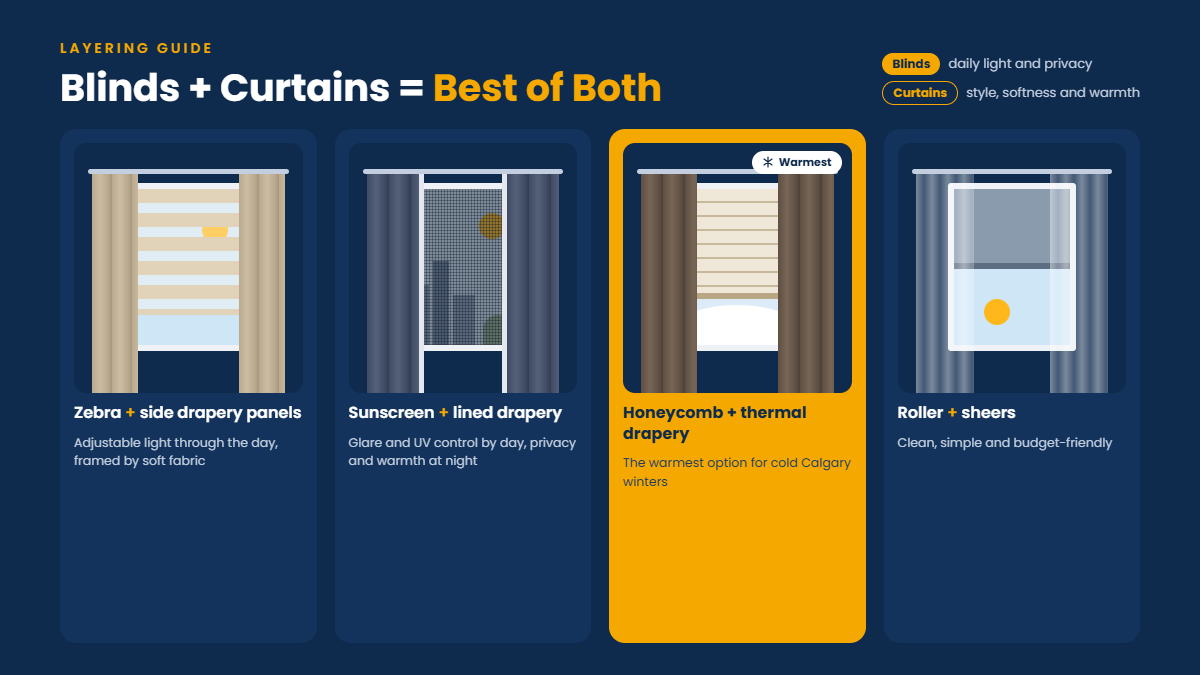
Layering curtains with blinds gives you the best of both: blinds handle daily light and privacy, and curtains add style, softness, and warmth. It is one of the most practical setups for living rooms that get used from morning to night.
Popular combinations of blinds for living room windows:
Blind | Paired with | Why it works |
|---|---|---|
Side drapery panels | Adjustable light through the day, framed by soft fabric | |
Lined drapery | Glare and UV control by day, privacy and warmth at night | |
Thermal or lined drapery | The warmest option for cold Calgary winters | |
Sheers | Clean, simple and budget-friendly |
When layering, install the blind inside the window frame and hang the curtains on a rod above and beyond it. This keeps the two from rubbing and lets the curtains cover the frame completely.
Custom vs Ready-Made Curtains: Which Is Better?
Custom curtains are the better choice for most living rooms because they are made to your exact window size, length and fullness. Ready-made curtains can fit a standard window on a tight budget, but they often fall short in size or width.
Factor | Custom curtains | Ready-made curtains |
|---|---|---|
Fit | Made to your exact measurements | Fixed sizes, often too short or too narrow |
Fullness | Planned for a full look | Usually one panel per side, often skimpy |
Fabric and lining | Wide choice, quality linings | Limited choice |
Large or unusual windows | Handled easily | Hard to fit |
Installation | Professional measuring and fitting | Do it yourself |
Cost | Higher upfront | Lower upfront |
Custom pricing depends on window size, fabric, lining, header style and hardware. If you are budgeting for layering, our guide to blinds prices in Canada breaks down typical costs for the blind side of the setup.
Conclusion
Choosing the right curtains for living room windows involves a few smart decisions. Pick a style that matches how you use the room, choose a fabric and lining that suit your light and sun exposure, and hang your panels high, wide and full. For the most flexible setup, layer your curtains with blinds so you get daytime light control and evening warmth in one window.
Ready to find the perfect look for your living room? Book a free in-home consultation with the MET Blinds team, and we will measure your windows, bring fabric samples, and help you design curtains and blinds that fit your space.
FAQs
What type of curtains is best for a living room?
Lined drapery is the most versatile choice because it adds privacy, warmth and a tailored look. Sheers suit bright rooms, and dream curtains work well if you want both soft daylight and evening privacy on one track.
Should living room curtains touch the floor?
Yes, in most cases. Curtains for living room windows look best when they just touch the floor or float about 1 cm above it. Shorter panels can make the window look smaller.
Do I need blackout curtains for my living room?
Not always. Blackout curtains for living room spaces make sense for TV-heavy rooms, west-facing windows or rooms that double as guest bedrooms. Otherwise, lined drapery or a layered blind gives enough light control.
Can I use curtains and blinds together?
Yes. Pairing blinds with curtains for living room windows is one of the best setups. A zebra, roller, sunscreen or honeycomb blind handles daily light, while the curtains in front add style and warmth.
How much do custom living room curtains cost?
The price depends on window size, fabric, lining, header style and hardware. Large windows and fuller panels cost more. A free in-home measure gives you an accurate quote for your specific windows.


