Slanted Window Blinds: More Options Than You Think
Table of Contents
What Are Slanted and Trapezoid Windows?
Why Standard Blinds Never Work for Angled Windows
What Are Your Best Covering Options in 2026?
How to Cover a Trapezoid Window Step by Step
Why Custom Shaped Window Blinds Are Worth It
Where Slanted Blinds Work Best in Your Home
FAQs
What if your most beautiful-looking window is also the one that seems impossible to properly cover? Odd angles, trapezoidal shapes, A-shaped roof lines, and slanted ceiling windows are all architectural wonders, yet to the majority of homeowners, they remain blind spots, literally. Fortunately for those who own such architectural elements, blinds for angled windows have evolved by leaps and bounds throughout the years, and in 2026, they've reached an entirely new level of excellence.
Whether you have a cathedral ceiling window, a geometric loft frame, or a classic trapezoid above your front door, there are now purpose-built trapezoid window treatments and angled window shades designed to fit every odd shape with precision, style, and full light control. The custom window treatment industry has grown significantly, with more homeowners investing in architectural solutions that match both form and function.
What Are Slanted and Trapezoid Windows?
A slanted window is a window whose edge follows an angled line instead of a conventional straight line horizontally or vertically. The common locations for such windows include A-frame structures, cathedral roofs, lofts, sunrooms, and modern buildings. Trapezoidal windows have four edges, with at least two edges that are not parallel to each other, making it impossible for conventional blinds to fit perfectly on them.
These windows became popular in mid-century modern design and have surged again in contemporary home builds throughout the 2020s. Vaulted ceilings, A-frame structures, and angled rooflines are increasingly common, which is why purpose-built solutions like custom-made slanted trapezoid blinds are in such high demand today.
Common types of odd-shaped windows include:
Window Type | Typical Location | Common Challenge |
|---|---|---|
Trapezoid | Above doors, A-frames | Four unequal sides |
Triangle | Loft peaks, gable ends | No parallel edges |
Angled ceiling | Sloped rooflines | Diagonal top edge |
Skylight | Flat or pitched roofs | Overhead, hard to reach |
Parallelogram | Modern builds | Offset angles |
Why Standard Blinds Never Work for Angled Windows
Homeowners think that any blind would be cut to fit an irregular window. They will not. Regular blinds are designed to cover rectangles; thus, when installing one on an irregularly shaped window, there will always be empty spaces around the angles, light leaking from the sloping sides, and crooked fabric.
For irregularly shaped windows, the covering should have the ability to maintain tension within the diagonal. Otherwise, the blind will droop, bunch, or automatically curl back up.
With custom window blinds, the problem is solved entirely. The blinds are fitted precisely with the interior cable following the angle of the window, ensuring a perfect fit right from the start.
What Are Your Best Covering Options in 2026?
The market for angled window shades has matured considerably. Here are the top solutions available right now:
Custom Fabric Slanted Blinds
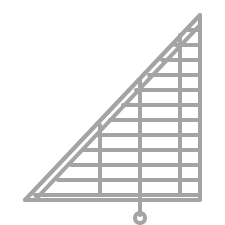
Custom fabric slanted window blinds using a cable-tension system operating along the angled sides of the window frame will be the most favored window blinds in 2026. The material will be flat and operate smoothly. There will be choices for filtering light and total darkness. Both manual and automated operations can be used. Automated operation of slanted windows using your phone or voice control will be a definite step up from previous days.
Skylight Blinds for Overhead Angles
When you have a window tilted in the roof, then it is essential to choose an option tailor-made for such an orientation. Skylight blinds are designed for use on overhead surfaces and surfaces with a slope, offering heat protection and ultraviolet ray-blocking features that ordinary window solutions lack. Additionally, they offer light-blocking options to control the amount of light let into the room below.
Honeycomb Shades for Angled Frames
Honeycomb blinds are another excellent option for trapezoid and angled windows. Their cellular structure provides thermal insulation, which is particularly valuable for angled ceiling windows that tend to lose or gain heat faster than standard walls. When custom-cut to your window's exact angles, honeycomb shades deliver both energy efficiency and a refined finish.
Motorized Blinds for Difficult Reach
Any window above arm's reach is a candidate for motorized blinds. In 2026, motorized systems are compatible with Google Home, Alexa, and Apple HomeKit, meaning you can adjust your high, angled window coverings without a ladder, a pole, or even leaving your seat.
How to Cover a Trapezoid Window Step by Step
How to cover a trapezoid window comes down to measuring it properly, as that is where mistakes are usually made in DIY projects.
Step 1: Determine Your Mounting Option
Determine whether you will be mounting from the inside, which involves fitting within the frame, or outside mounting, which covers the entire frame. The latter option is preferable when working with trapezoids because it gives you more options with the head rail.
Step 2: Measure the Lengths of All Four Sides
Trapezoids have four sides of unequal length. You will need to measure their heights and widths on both ends. Write down all four measurements.
Step 3: Record the Slope Angles
To calculate the slope angles, use either a digital protractor or a regular one. These numbers are required to determine how the fabric is cut and which way the tension wire runs.
Step 4: Choose Your Fabric
Choose fabric that filters sunlight if you need to have natural sunlight with reduced glare in your room, or fabric that blocks out light if the area is for sleeping or watching movies. Both options can be done for custom-shaped window blinds.
Step 5: Book a Professional Measure
To ensure a highly accurate measurement, having an in-home professional measurement removes all guesswork. This is because custom blinds are manufactured to measure.
Why Custom Shaped Window Blinds Are Worth It
There are many reasons why custom blinds for angled windows represent a worthwhile investment that will return their cost very quickly indeed. Firstly, they protect your furnishings. Angled windows, especially those in sloped ceiling areas, allow the sun's rays to hit furniture, carpets, and other surfaces at much stronger angles than normal. A window treatment made from UV-resistant materials blocks out the light before any damage can be done.
Secondly, they increase energy efficiency. Ceiling windows on an angle are renowned for leaking heat in cold weather, but also letting in too much in warmer seasons. A good fitting of a thermal material, such as a honeycomb blind, acts as an insulation barrier, lessening the burden on your HVAC system.
Finally, they finish off your interior décor. It makes sense not to have an exposed architectural window. Rather, use it to showcase the beauty of a perfect blind fit.
Where Slanted Blinds Work Best in Your Home
Knowing where slanted blinds work best in your home can help you choose the right window treatment for uniquely shaped windows. They are especially useful in rooms with angled ceilings, skylights, and other windows where standard blinds may not fit properly.
Living Rooms with Cathedral Ceilings:
Windows that are either trapezoidal or triangular in shape above the seating area of the room can make excellent use of slanted blinds, which filter afternoon sunlight but still let you enjoy the view.
Bedrooms with Angled Ceiling Windows:
Darkening window treatments are highly recommended for bedrooms with angled roof windows, especially in summer, since early-morning sunlight shines through them.
Sunrooms and Conservatories:
Sunrooms usually consist of regular windows and windows placed at an angle in relation to the walls of the house. A mix of skylight blinds for the angled windows and roller/zebra blinds for the vertical windows makes for a coordinated appearance.
Lofts and A-Frame Spaces:
he characteristic triangular/trapezoidal windows at the end of a loft/A-frame room are perfect candidates for slanted blinds since they offer protection against excessive heating and enhance the architectural feel of the room.
Conclusion
Slanted window blinds are no longer a niche product that requires months of searching and waiting. In 2026, custom solutions exist for every window shape, every budget, and every control preference, from manual to fully motorized smart systems. Whether you need trapezoid window treatments for a dramatic A-frame peak, angled window shades for a sloped-ceiling bedroom, or skylight blinds for a roof window that bakes the room in summer, the right solution is available and closer than you think.
Do not let an architectural window go uncovered because it looks too complicated to solve. Visit Met Blinds to explore a full range of custom window treatment options and book a free in-home consultation with a specialist who measures and fits every blind to your exact window, guaranteed.
FAQs
Q1: What are slanted window blinds?
The slanted window blinds refer to custom-fit window blinds that can be used to cover the non-rectangular windows, such as the trapezoidal or angular windows, using tension cables and precise cutting of the fabrics.
Q2: Can you put blinds on a trapezoid window?
Yes. Custom trapezoid window treatments are precision-made to match all four sides of your window, including the angled edges, for a polished, properly fitted result.
Q3: What is the best covering for angled ceiling windows?
The honeycomb blinds serve well for the purpose of insulation, while the room-darkening window blinds are preferable when covering the angled ceiling windows.
Q4: How do I measure a trapezoid window for blinds?
Measure the top, bottom, and both sides, then document all the angles that you have found by using a digital angle finder. When booking an expert to measure the angles in the comfort of your home, you will get the most accurate measurements.
Q5: Are motorized slanted window blinds worth it?
Yes, because motorized slanted window blinds are designed to be compatible with Alexa, Google Home, and Apple HomeKit, meaning that they can be controlled remotely without the need for ladders.
Q6: What is the difference between skylight blinds and slanted blinds?
Skylight blinds are built for roof-plane overhead windows, while slanted window blinds cover angled vertical or near-vertical frames. Both use custom tension systems but differ in mounting hardware and fabric orientation.