Do Thermal Curtains Really Keep Your Home Warmer in a Canadian Winter?
 Do Thermal Curtains Really Keep Your Home Warmer in a Canadian Winter
Quick Answer
Yes. Lined thermal curtains that hang close to the glass and reach the sill or floor can noticeably cut heat loss and cold drafts at the window. On their own, they make a modest difference. Paired with honeycomb blinds, they create one of the most effective window insulation setups for a Canadian winter.
Ever sat on the couch on a January evening and felt a chill coming off the window, even with the furnace running? That cold zone is heat leaving your home. According to Natural Resources Canada, windows, doors, and skylights can account for up to 35% of a home's total heat loss. Replacing windows is expensive, so many homeowners start with thermal drapes instead. In this guide, we explain how they work, what they can and cannot do, how to choose the right panels, and why our installers often pair them with honeycomb blinds for Calgary and Alberta homes.
What Are Thermal Curtains?
Thermal curtains are curtain panels made with additional insulation, often a thick lining attached to the back of the face fabric. This lining, along with tightly woven or heavy fabric, helps prevent heat and air from moving between your room and the cold glass.
Standard curtains are purely decorative. Winter insulated curtains are meant to act as a barrier. There are several common characteristics of thermal drapes:
A dense lining, often a thermal or blackout layer
Tightly woven face fabric that lets less air pass through
Enough fullness that the panels close completely without gaps
Longer lengths that reach the sill or the floor
Our custom drapery is made to measure with energy-efficient lined panels, so each panel is sized to cover the full window and frame, not just the glass.
How Thermal Curtains Work in a Canadian Winter
Windows lose heat in two main ways. Warm room air touches the cold glass, cools down, and sinks toward the floor, pulling more warm air toward the window. This loop is why you feel a draft near windows even when they are sealed. Heat also passes directly through the glass to the outside.
Thermal drapes interrupt both. The fabric and lining trap a layer of still air between the panel and the window, which slows heat transfer. Closed panels also block that cold air from spilling into the room.
How much difference does it make? The U.S. Department of Energy reports that most conventional draperies can reduce heat loss from a warm room by up to 10% when drawn in cold weather. Lined draperies that are sealed at the top, sides, and centre can do noticeably better, so fit is what makes the biggest difference.
This matters in places like Calgary, where cold snaps can push temperatures below minus 30°C, and chinooks can swing the outdoor temperature by 20 degrees or more in a day. Your windows face a long heating season with sharp temperature changes, so every layer of window insulation for winter counts.
What Are the Benefits of Thermal Curtains?
Lined drapes offer more than warmth. Here is what you can realistically expect.
Benefit | What to expect |
|---|---|
Less heat loss | Up to about 10% from a typical drawn drape, more when well sealed |
Lower energy bills | Modest savings, since your furnace runs a little less on cold nights |
Fewer drafts | A noticeable reduction in the cold air falling off the glass |
Less noise | Heavy, lined fabric softens outside sound, though it won't soundproof a room |
Light control | Blackout linings darken bedrooms and media rooms |
Fade protection | Closed panels shield floors and furniture from strong prairie sun |
The most noticeable change for most people is comfort. Rooms feel less chilly near the windows, so you can sit by them without reaching for a blanket.
Thermal Curtains vs Thermal Blinds (Honeycomb): Which Insulates Better?
Honeycomb blinds insulate better than thermal curtains on their own. Lined drapes still add value because they cover the window frame and trim, not just the glass.
Honeycomb blinds, sometimes called thermal blinds or insulated blinds, are made from pleated fabric cells that trap air like a honeycomb. The U.S. Department of Energy says tightly installed cellular shades can reduce heat loss through windows by 40% or more. The City of Calgary also notes that cellular shades have excellent thermal properties and help reduce winter heat loss.
Feature | Thermal Curtains | Honeycomb Blinds |
|---|---|---|
How they insulate | Lined fabric traps air over the whole window area | Air-filled cells sit right against the glass |
Insulation level | Moderate | High |
Covers frame and trim | Yes | No, sits inside or just over the frame |
Light control | Open or closed | Blackout or light-filtering, adjustable height |
Look | Soft, layered, decorative | Clean, minimal |
Best for | Living rooms, bedrooms, patio doors | Every room, especially cold or north-facing ones |
Both are energy-efficient window coverings. The right choice depends on your room, your style and how cold your windows feel.
How to Choose Thermal Drapes
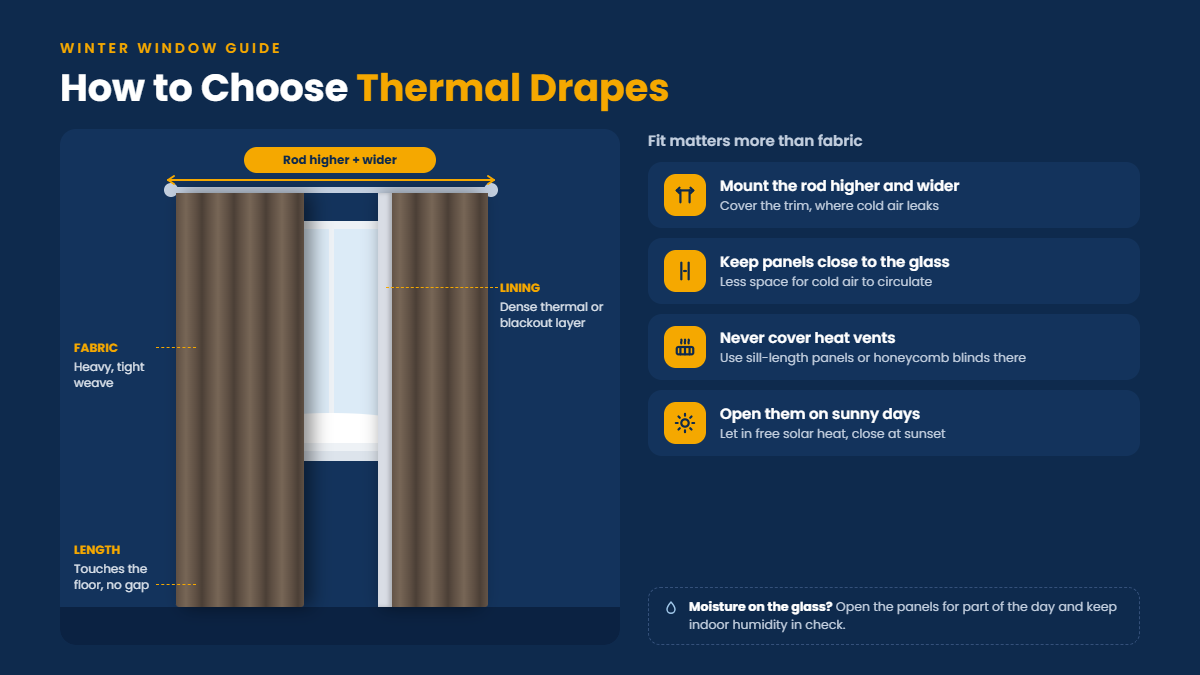
Choose thermal drapes with a dense lining, a tight weave, enough fullness to close completely and a length that reaches at least the sill. Here is what to check.
 How to Choose Thermal Drapes
Lining
The lining does most of the insulating work. Thermal and blackout linings add a dense layer behind the face fabric. A blackout lining also blocks light through the fabric, which helps bedrooms stay dark.
Fabric
Heavier, tightly woven fabrics insulate better than loose or sheer weaves. Sheers look beautiful but offer little insulation unless you layer them with a lined panel.
Length
Floor-length panels that just touch the floor or sit on the sill work best. A gap at the bottom lets cold air escape into the room.
Fit
Fit matters more than fabric. Our installers follow a few rules on every winter install:
Mount the rod higher and wider than the window. We extend the rod past the frame on each side so the panels cover the trim, where a lot of cold air leaks.
Keep panels close to the glass. The less space between the drape and the window, the less room cold air has to circulate.
Never cover heat registers or baseboard heaters. In many Canadian homes, the furnace vent sits right under the window. Drapes that hang over it trap warm air against the cold glass. In those rooms, we suggest sill-length panels or honeycomb blinds instead.
Open them on sunny days. South-facing windows bring in free solar heat. Open your drapes during the day and close them at sunset.
One more tip: very tight coverings can increase condensation on the glass during deep cold. If you notice moisture, open the panels for part of the day and keep indoor humidity in check.
Pairing Thermal Curtains With Honeycomb Blinds for Better Insulation
For the warmest windows, we recommend layering. Install honeycomb blinds inside the window frame, then hang lined drapery in front of them on a rod mounted above and beyond the frame.
Each layer handles a different job:
Honeycomb blinds sit close to the glass and trap air in their cells, blocking most of the heat loss.
Thermal drapes cover the frame and trim, stop drafts at the edges and add a second layer of still air.
The result is a warmer room, fewer cold spots, and better light control. You can lower the honeycomb blind for daytime privacy and close the drapes at night for full insulation. This setup works especially well on large living room windows, patio doors, and north-facing bedrooms. Our installer picks for the best blinds for Calgary winters explain how to choose insulated blinds for cold rooms.
Conclusion
So, do thermal curtains really keep your home warmer? Yes, especially when they are lined, floor-length, and fitted close to the window. On their own, they reduce drafts and trim heat loss. Paired with honeycomb blinds, they give you some of the strongest window insulation available without replacing your windows. Remember to keep vents clear and open your drapes on sunny days to soak up free heat.
Ready to make your windows warmer before the next cold snap? Book a free in-home consultation with MET Blinds, and our team will measure your windows and help you pick the right drapery and honeycomb combination for your home.
FAQs
Do thermal curtains really make a difference in winter?
Yes. Drawn drapes can cut heat loss from a room by up to 10%, and well-sealed, lined panels can do even better. You'll feel the biggest change in the drafts near the glass.
Are thermal curtains or honeycomb blinds better for insulation?
Honeycomb blinds insulate better on their own, cutting heat loss by 40% or more when tightly installed. Thermal curtains add coverage over the frame, so using both together gives the best result.
Should I close my thermal drapes during the day?
Close them on north-facing windows and at night. Open them on sunny south-facing windows during the day to let in free solar heat.
How much do thermal curtains cost?
Custom thermal drapes are priced by window size, fabric, lining, and hardware, so a quick in-home measure gives the most accurate quote. Honeycomb blinds typically run about $120 to $350 per window, which helps when you are budgeting for layering.
Do thermal curtains help with noise?
Somewhat. Heavy, lined thermal curtains absorb some outside noise, which helps in street-facing rooms, but they will not fully soundproof a room.


