Types of Blinds Explained for Canadian Homes and Which One Suits Each Room
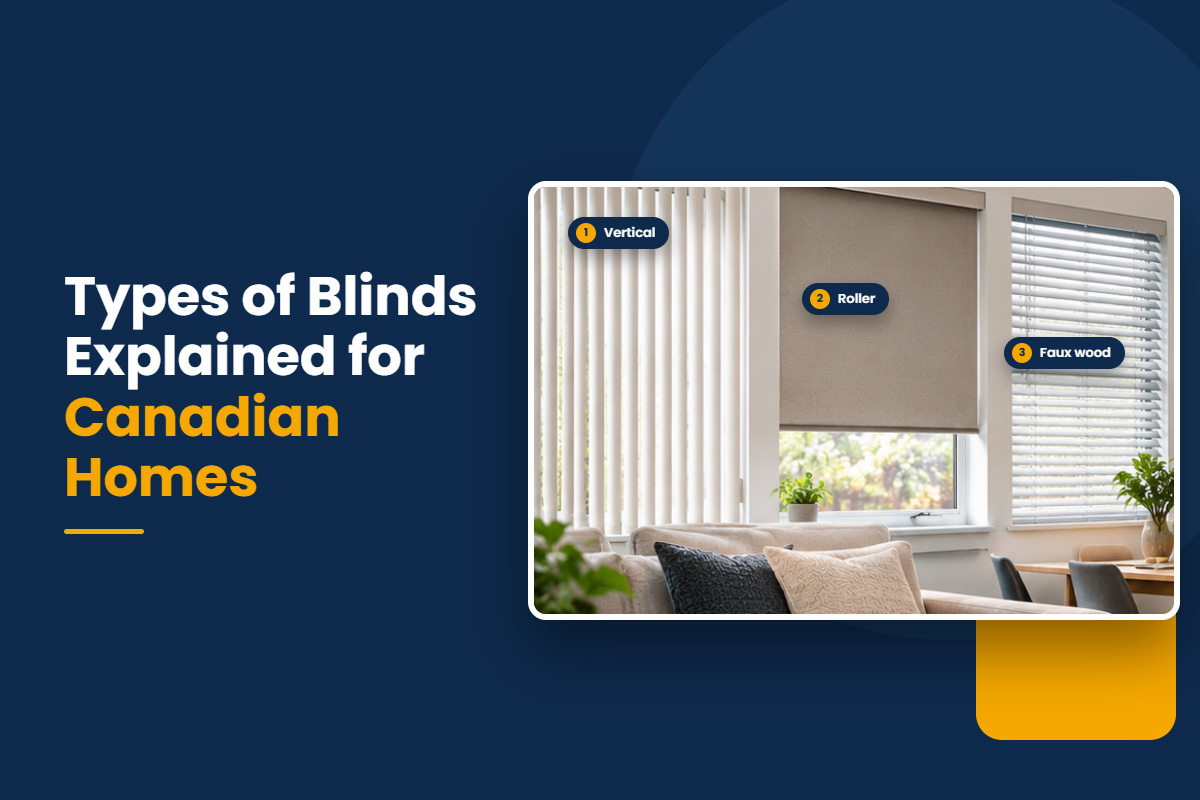 Types of Blinds Explained for Canadian Homes
Quick Answer
These are the types of blinds we custom make and install for Canadian homes:
Ever had the experience of installing new blinds, taking a few steps back, only to notice that there is way too much light getting in, or just not enough? This is common because most blind types look similar in a sample book but perform very differently once installed in a window. Bedrooms need darkness, kitchens need cleanable options, and sunny Calgary living rooms need glare control that doesn’t block the view. In this guide, we’ll explore how blinds and shades differ, review all our styles, and pair them with the rooms they suit best.
Blinds vs Shades: What Is the Difference?
Quick answer: Traditional blinds use slats or vanes that tilt, while shades use a continuous piece of fabric that rolls, folds, or stacks. Today, most people use the two words interchangeably.
Zebra blinds are a particularly clear example: they are made of fabric, but their bands control light much like tilting slats, so everyone calls them blinds. When you compare different types of window shades and blinds, it helps to focus less on the name and more on three practical questions:
How much light do you want to block?
How much privacy do you need, day and night?
How much insulation does the window need?
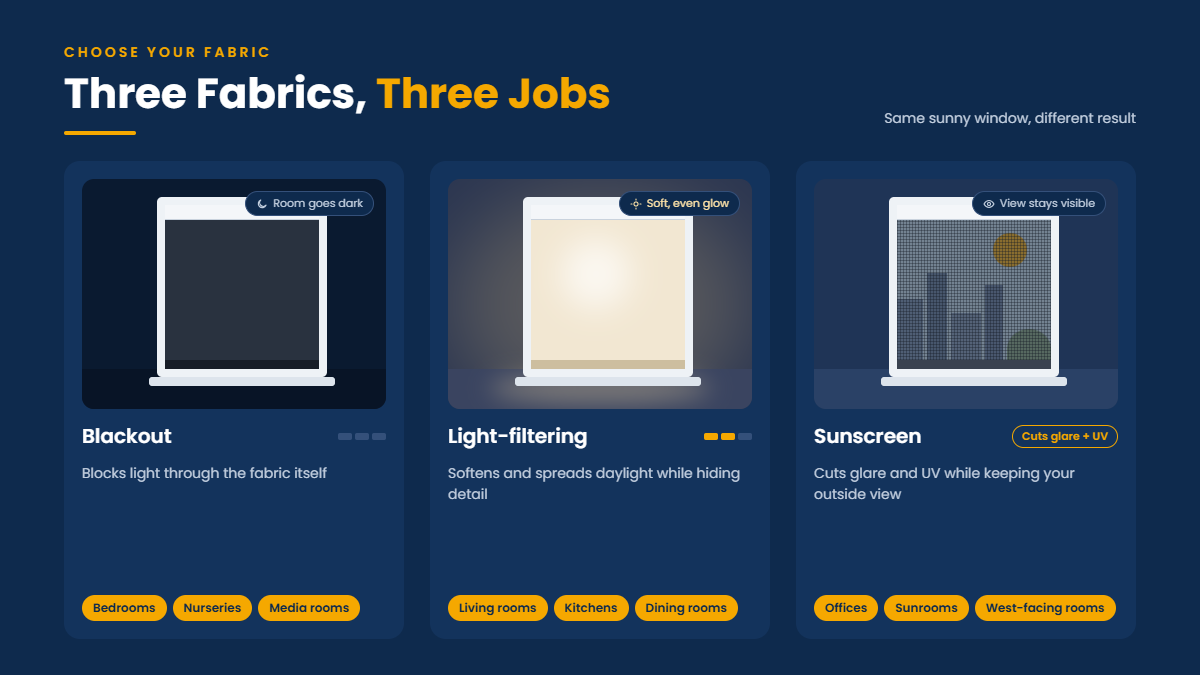
Blackout vs Light-Filtering: Which Do You Need?
Choose blackout fabric for rooms where you sleep, nap, or watch movies. Choose light-filtering fabric for rooms where you want soft daylight and daytime privacy.
Fabric type | What it does | Best rooms |
|---|---|---|
Blackout | Blocks light through the fabric itself | Bedrooms, nurseries, media rooms |
Light-filtering | Softens and spreads daylight while hiding detail | Living rooms, kitchens, dining rooms |
Sunscreen (screen fabric) | Cuts glare and UV while keeping your outside view | Offices, sunrooms, west-facing rooms |
Keep in mind that blackout fabric alone does not guarantee a pitch-black room. Light can sneak around the edges, so mounting style matters too.
 Blackout vs Light-Filtering Which Do You Need
What Are the Main Types of Blinds for Canadian Homes?
The main types of blinds for Canadian homes are zebra, roller, double roller, sunscreen, honeycomb, Roman, trifold, butterfly, skylight, slanted, and sliding panel styles. Each one solves a different problem, so here is what to expect from every option.
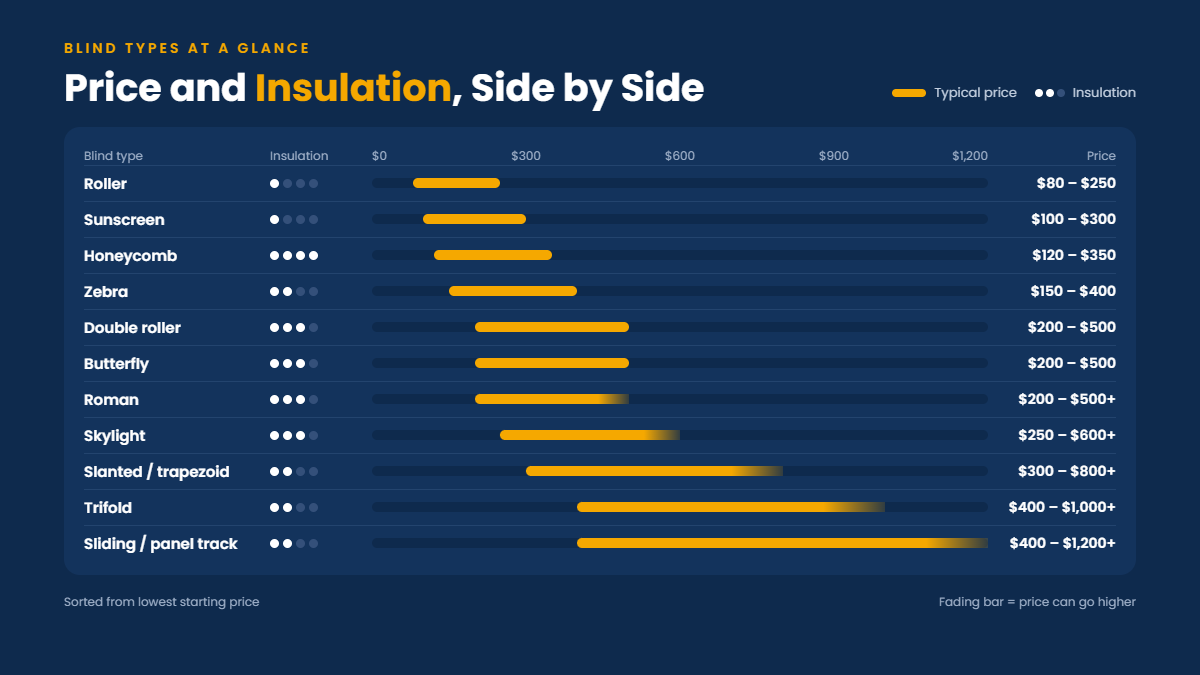
The prices below are typical planning ranges per standard window before tax. Window size, fabric grade, and motorization affect the final price, and Alberta adds 5% GST. Our complete guide to blinds prices in Canada breaks down these cost factors in more detail.
Zebra Blinds
Zebra blinds come in dual layers with alternating sheer and opaque stripes. You can line up sheer stripes for light entry or stagger them for privacy.
Benefits: Easy light adjustment without moving the blinds, contemporary style, and dust- and water-repellent polyester material.
Best rooms: Living rooms, home offices, bedrooms (with blackout bands), kitchens
Typical price: $150 to $400 per window
Roller Blinds
Roller blinds consist of one sheet of fabric that rolls up easily on a tube mounted above the window. They look neat, are simple to use, and come in blackout and filtering fabrics.
Benefits: Minimal look, easy to clean, one of the most budget-friendly custom options
Best rooms: Almost any room, especially kitchens, bathrooms, and basements
Typical price: $80 to $250 per window
Double Roller Blinds
A double roller blind consists of two separate roller blinds within a single headrail, which is typically a light-filtering blind followed by a blackout blind.
Benefits: Daytime light and nighttime darkness on one window, no need to choose between them
Best rooms: Primary bedrooms, guest rooms, nurseries, media rooms
Typical price: $200 to $500 per window
Sunscreen Blinds
Sunscreen blinds are roll-up blinds constructed of a loose weave of screening material. They reduce glare and filter out most harmful UV rays while leaving the outdoor view intact.
Benefits: Protect floors and furniture from fading, reduce screen glare, keep rooms bright
Best rooms: Home offices, sunrooms, living rooms with big west- or south-facing windows
Typical price: $100 to $300 per window
Sunscreen fabric filters light; it is not a blackout fabric. When the room is lit at night, people outside can see in, so pair sunscreen blinds with drapery or a blackout layer for night privacy.
Honeycomb Blinds
Honeycomb blinds, also called cellular shades, are built from pleated fabric cells that trap air. We offer single, double, and triple cell options.
Benefits: The best insulating choice in our lineup, helps reduce heat loss in winter and heat gain in summer, absorbs some sound, comes in blackout and light-filtering fabrics
Best rooms: Bedrooms, drafty rooms, north-facing windows, large living room windows
Typical price: $120 to $350 per window
This is the style we recommend most for cold Alberta winters. Our installer picks for winter blinds in Calgary explain why in more detail.
Roman Shades
Roman shades are fabric shades that fold into pleats as they rise. We offer shades in hobbled, relaxed-fold, flat, and luxury-fold styles.
Benefits: Warm, tailored look; lined fabric adds a layer at the glass; blackout and light-filtering options
Best rooms: Living rooms, dining rooms, bedrooms, formal spaces
Typical price: $200 to $500+ per window
Trifold Blinds
Trifold blinds are folding blinds that can be used on large windows and sliding glass doors. They fold to one side instead of raising upwards.
Benefits: Clean modern look, flexible full or partial coverage, works with smart home systems
Best rooms: Open-concept living areas, patio doors, large picture windows
Typical price: $400 to $1,000+ per opening
Butterfly Blinds
Butterfly blinds are decorative fabric shades that gather into soft horizontal folds when raised, creating a cascading effect.
Benefits: More decorative than a flat roller, adjusts from soft filtered light to room darkening, layered fabric adds some temperature control
Best rooms: Dining rooms, living rooms, primary bedrooms where style matters
Typical price: $200 to $500 per window
Skylight Blinds
Skylight blinds run along a track so the fabric stays in place on an angled or overhead window. They come in blackout and light-filtering fabrics.
Benefits: Controls heat gain and glare from above, protects flooring and furniture from fading
Best rooms: Sunrooms, kitchens, bedrooms, and lofts with skylights
Typical price: $250 to $600+ per skylight
Our guide on choosing the right skylight shades covers sizing and fabric choices for overhead windows.
Slanted and Trapezoid Blinds
These blinds are custom-built for angled, A-frame, and trapezoid windows. A tension cable system keeps the fabric taut along the slope.
Benefits: Covers shapes that standard blinds cannot, reduces solar heat through high windows
Best rooms: Vaulted living rooms, A-frame cabins, bonus rooms, stairwells
Typical price: $300 to $800+ per window
Sliding Window Blinds and Panel Tracks
Sliding window blinds and panel tracks have large fabric panels that move along the track. They cover patio doors and large windows without obstructing the door handle or the passageway.
Benefits: Easy daily access to the door, panels can double as room dividers, blackout and light-filtering fabrics
Best rooms: Patio doors, sliding glass doors, wall-to-wall windows
Typical price: $400 to $1,200+ per opening
Comparison Table of Window Blind Types
Blind type | Light control | Insulation | Best for | Typical price |
|---|---|---|---|---|
Zebra | Adjustable bands | Low to moderate | Living rooms, offices | $150 to $400 |
Roller | Blackout or filtering | Low | Kitchens, bathrooms, basements | $80 to $250 |
Double roller | Filtering plus blackout | Moderate | Bedrooms, nurseries | $200 to $500 |
Sunscreen | Glare and UV control | Low | Offices, sunrooms | $100 to $300 |
Honeycomb | Blackout or filtering | High | Bedrooms, cold rooms | $120 to $350 |
Roman | Blackout or filtering | Moderate | Living and dining rooms | $200 to $500+ |
Trifold | Blackout or filtering | Low to moderate | Wide windows, patio doors | $400 to $1,000+ |
Butterfly | Filtering to room darkening | Moderate | Decorative spaces | $200 to $500 |
Skylight | Blackout or filtering | Moderate | Overhead windows | $250 to $600+ |
Slanted/trapezoid | Filtering or room darkening | Low to moderate | Angled windows | $300 to $800+ |
Sliding/panel track | Blackout or filtering | Low to moderate | Sliding doors | $400 to $1,200+ |
Prices are planned ranges per window or opening before GST. Your quote depends on size, fabric, and controls.
 Comparison Table of Window Blind Types
Which Type of Blinds Is Best for Each Room?
Quick answer: Use blackout honeycomb or double roller shades in bedrooms, zebra or Roman shades in the living areas, roller shades in kitchens and baths, and panel tracks in patio doors. Room-by-room detail follows.
Bedrooms and Nurseries
Real darkness is essential to bedrooms and nurseries, so start with blackout fabric. Use double roller shades to provide one thin layer during the day and full darkness at night. For bedrooms that seem cold in January, try blackout honeycomb shades. For children's rooms, always choose cordless or motorized options. Our list of safe, cordless blinds for nursery rooms goes deeper on this topic.
Living Rooms
Zebra blinds provide daytime privacy to living rooms without closing them off, while Roman or butterfly blinds work well for rooms that require some decoration. For a west-facing room or an office, use sunscreen blinds to avoid screen glare in the afternoons.
Kitchens and Bathrooms
Use roller or zebra blinds with easy-to-maintain polyester material. They are more durable in humid conditions than other materials. Avoid using fabric Roman shades near a shower or over a cooking stove, as steam and grease can damage folded material.
Patio Doors and Large Windows
Trifold blinds, sliding window blinds, and panel tracks are the best types of window coverings for wide openings. They stack to the side and stay clear of the door handle, so the fabric does not rub and wear.
Vaulted Ceilings, A-Frames, and Skylights
Slanted, trapezoidal, and skylight blinds are made for these shapes. Since these windows are often out of reach, we strongly suggest motorizing them.
Why Does the Calgary Climate Matter?
Calgary sits more than 1,000 metres above sea level and is one of the sunniest major cities in Canada. That means strong UV that fades hardwood and furniture, plus cold winters with chinooks that swing the indoor temperature near your windows. For most Calgary and Alberta homes, we suggest honeycomb blinds for insulation on north-facing and bedroom windows and sunscreen or zebra blinds on sunny south- and west-facing glass.
What Do Our Installers Wish Every Customer Knew?
In the homes we measure and install across Alberta, our installers see the same few mistakes again and again:
Choosing light-filtering fabric for a bedroom. It looks fine in the sample, but the room still glows at 6 a.m. in June. If you sleep in that room, go blackout.
Expecting inside-mounted blackout blinds to be pitch black. Every inside mount leaves a small gap at each side. For true darkness, outside-mount the blind and overlap the frame by about 7 to 10 cm (3 to 4 inches) on each side, or pair it with side channels or curtains.
Measuring only once. For inside mounts, measure the width at the top, middle, and bottom of the frame and use the smallest number. Window frames are rarely perfectly square.
Forgetting frame depth. Double roller headrails need more depth than a single roller, so check before you choose an inside mount.
Ordering one huge blind for a very wide window. Extra-wide fabric is heavy to lift and can sag over time. Splitting the window into two or three blinds, or going motorized, usually works better.
Which Control Options Should You Choose?
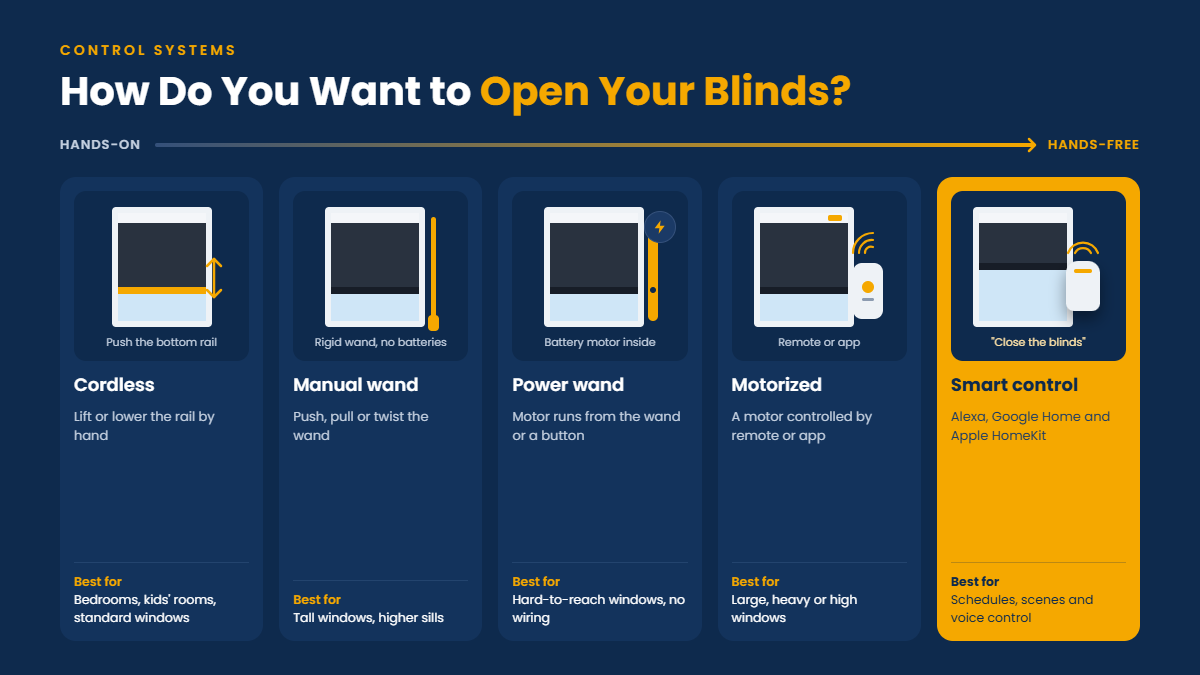
Quick answer: Choose cordless for everyday windows, a wand for tall windows you can still reach, and motorized or smart control for large, high, or hard-to-reach windows.
Control | How it works | Best for |
|---|---|---|
Lift or lower the bottom rail by hand | Bedrooms, kids' rooms, standard windows | |
Manual wand | Push, pull, or twist a rigid wand, no batteries | Tall windows, higher sills |
Power wand | Battery-powered motor triggered by the wand or a button | Hard-to-reach windows without wiring |
Remote or app-controlled motor | Large, heavy or high windows | |
Smart control | Works with Alexa, Google Home and Apple HomeKit | Schedules, scenes and voice control |
Motorized blinds also let you set schedules, so your blinds close in the afternoon to protect floors while you are at work. If you already use a smart speaker, our guide on controlling your blinds with Alexa and Google Home explains the setup options. Motorized pricing usually sits around $250 to $900+ per window, depending on size and motor type.
 Which Control Options Should You Choose
What Are Canada's Rules on Corded Blinds?
Since May 1, 2021, every window covering sold in Canada, custom or off-the-shelf, must meet Health Canada's Corded Window Coverings Regulations. In simple terms, any cord a child can reach must be no longer than 22 cm, and any loop a reachable cord can form must have a perimeter of no more than 44 cm. Long dangling pull cords are no longer allowed on new products.
Health Canada's advice is simple: the safest window coverings have no cords you can see or touch. You can read the official background in Health Canada's announcement of the Corded Window Coverings Regulations. If you still have older corded blinds at home, especially near a crib or bed, replacing them should be a priority.
Conclusion
Picking between the types of blinds gets much easier once you match each window to its job. Use blackout double roller or honeycomb blinds where you sleep, zebra or Roman shades where you relax, roller blinds where things get steamy or messy, and panel tracks or trifold blinds on patio doors. For Calgary's bright sun and cold winters, honeycomb and sunscreen blinds pull a lot of weight. Then choose cordless or motorized controls so every window is safe and easy to use.
Not sure which style suits your windows? Book a free quote with the MET Blinds team and our installers will measure your windows, help you compare fabric samples, and build a plan that fits your rooms and your budget.
FAQs
What are the most common types of blinds in Canadian homes?
Zebra, roller, and honeycomb blinds are among the most common types of blinds in Canadian homes. Roman shades are a favourite for more traditional rooms.
Which type of blinds is best for keeping heat in during winter?
Honeycomb blinds. Their air-filled cells slow heat loss through the glass, and double- or triple-cell options insulate even better.
How much do custom blinds cost in Canada?
Most custom blinds cost about $80 to $500 per window, depending on type, size, and fabric. Motorized blinds run about $250 to $900+, and Alberta adds 5% GST.
Which window blind types give the most blackout?
The best types of blinds for maximum blackout are double roller, blackout roller, blackout honeycomb, and blackout Roman shades. Outside-mount them over the frame to avoid light gaps at the sides.
Can I mix different types of blinds in the same home?
Yes. Most homes mix types of blinds by room, such as blackout honeycomb in bedrooms and zebra blinds in the living room. Keep the same hardware finish and similar colours so everything looks consistent.


