Inside Mount vs Outside Mount Blinds: How to Pick the Right Fit for Your Windows
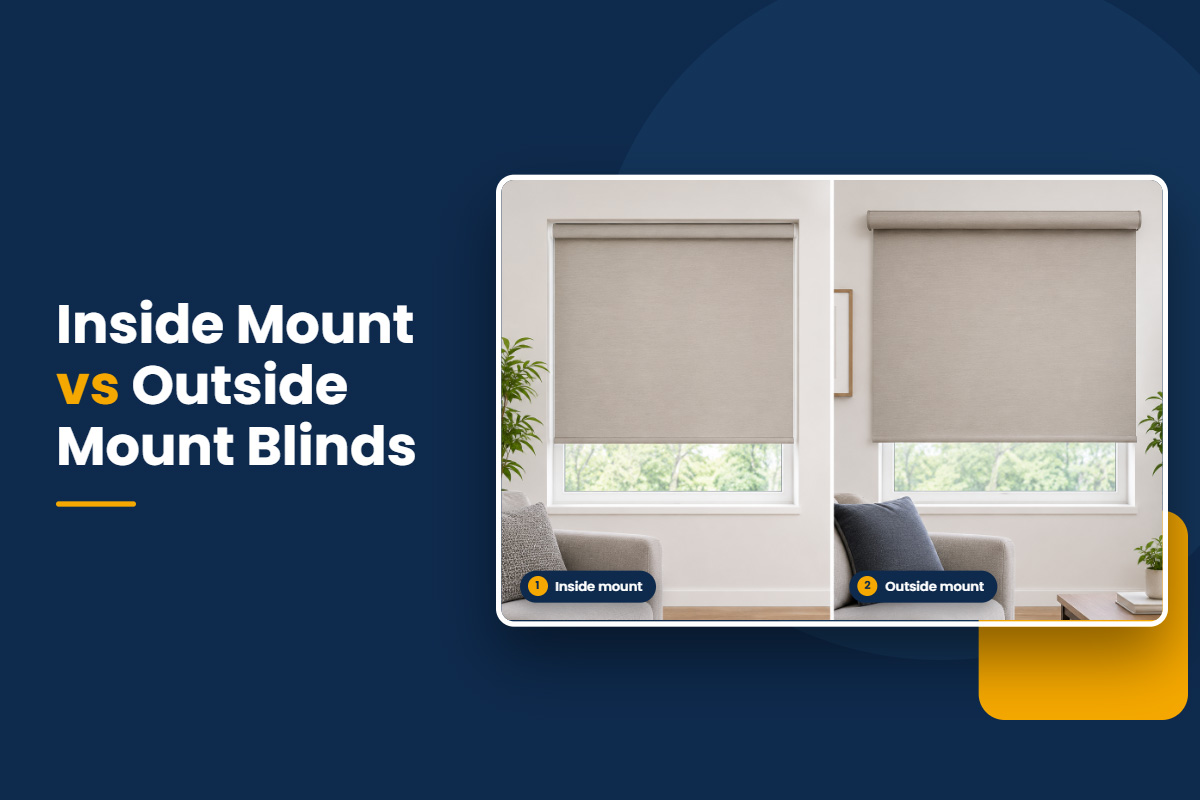 Inside Mount vs Outside Mount Blinds
Quick Answer
Choose an inside mount when your window frame has enough depth, the frame is fairly square, and you want a clean, built-in look. Choose an outside mount when the frame is shallow or uneven, a crank handle is in the way, or you want the darkest possible room with fewer light gaps.
Ever ordered blinds, only to find they won't fit inside the frame or leave thin strips of light down each side? Most of those problems start with one decision: the mount. The choice between inside mount vs outside mount blinds affects how your windows look, how dark the room gets and even how big the window appears. It also changes how you measure. In this guide, we explain both options, compare them side by side, cover depth requirements, and show you how to measure for each. Our installers make this call on almost every window across Calgary, Edmonton, Red Deer and Lethbridge, so we share what works in real homes.
What Are Inside Mount Blinds?
Inside mount blinds are installed within the window opening, with the brackets fastened to the top of the frame. The blind sits neatly inside the recess, so your trim and casing stay visible.
Inside mounts give a tailored, built-in look that suits modern homes and windows with attractive trim. They also leave room in front of the window for curtains, which is why they work so well when layering blinds with drapery.
The trade-off is light. Because the blind has to fit inside the opening, there is always a small gap at each side. In a living room, that's barely noticeable, but in a bedroom at sunrise, you'll see it.
What Are Outside Mount Blinds?
Outside mount blinds are installed on the wall or trim above the window, so the blind covers the whole opening plus some of the wall around it.
Outside mounts work on almost any window, regardless of frame depth or shape. They block more light at the edges, hide uneven or worn trim, and can make a window look taller and wider when mounted higher and extended past the frame.
The trade-off is that the blind and its headrail are more visible, and it can stick out from the wall, which matters near a door or a busy walkway.
Inside Mount vs Outside Mount Comparison Table
Factor | Inside Mount | Outside Mount |
|---|---|---|
Look | Clean, built-in, shows off trim | Bolder, covers trim, frames the window |
Light gaps | Small gaps at each side | Fewer gaps thanks to the overlap |
Best for blackout | Good with a closed cassette | Best, especially with generous overlap |
Frame depth needed | Yes, varies by product | No |
Works with uneven frames | Not well | Yes |
Room for curtains | Yes, in front | Possible, but needs a deeper rod |
Window obstructions (cranks, handles) | Can interfere | Clears them |
Makes windows look bigger | No | Yes, when mounted high and wide |
When Should You Choose Inside Mount Blinds?
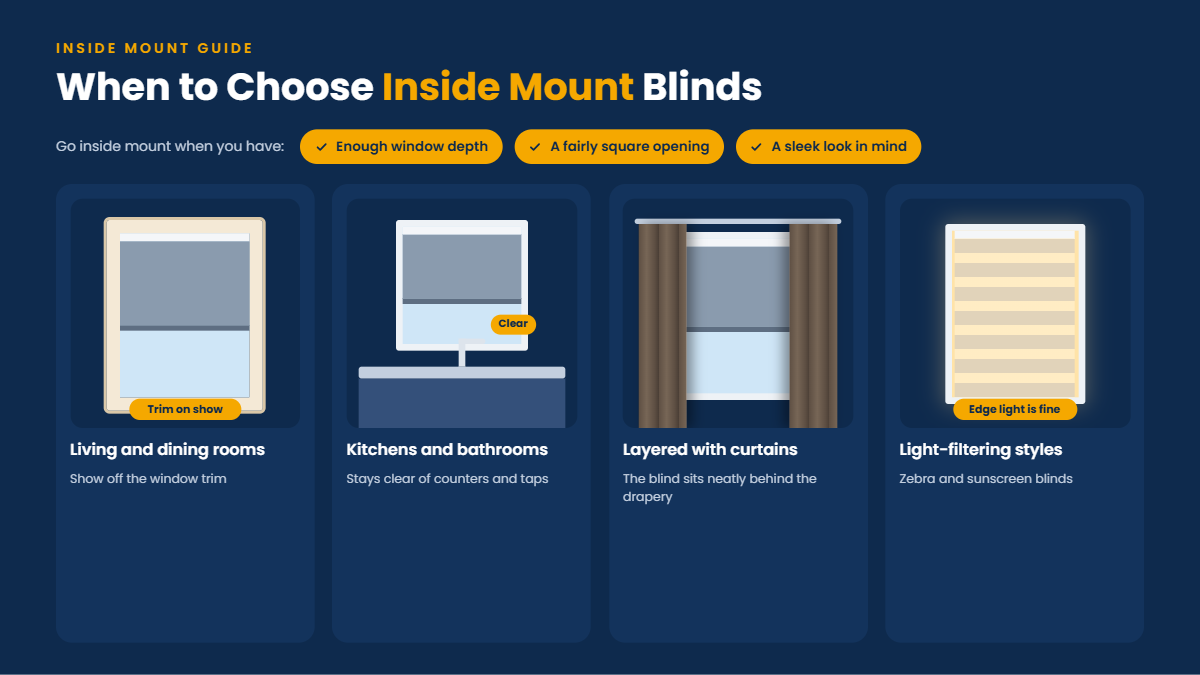
Choose inside mount blinds when the window has enough depth, the opening is fairly square, and you want a sleek look.
 When Should You Choose Inside Mount Blinds
Inside mounts work well for:
Living rooms and dining rooms where you want to show off the window trim
Kitchens and bathrooms, where a blind tucked into the frame stays clear of counters and taps
Windows you plan to layer with curtains, since the blind sits behind the drapery
Light-filtering styles like zebra blinds and sunscreen blinds, where a little edge light doesn't matter
Many newer homes in Calgary have drywall returns instead of wooden casing, which often gives plenty of room for an inside mount. We still check every window, because depth can vary even within the same house.
When Should You Choose Outside Mount Blinds?
Choose outside mount blinds when you need maximum darkness, the frame is too shallow, or something gets in the way of an inside mount.
Outside mounts are the better choice for:
Bedrooms and nurseries, where blackout roller blinds or double roller blinds need overlap to block edge light
Casement windows with crank handles, which are common in Canadian homes and can stop an inside mount blind from lowering fully
Shallow or out-of-square frames, where an inside mount would sit crooked or stick out
Patio and sliding doors, where the blind needs to clear the door handle
Small windows you want to look larger
For more on darkening a bedroom, see our picks for the best blackout blinds for a truly dark bedroom. If you are leaning toward Roman shades, our guide to outside mount Roman shades covers that style in detail.
Installer insights
Here is what our installers see most often on measuring visits:
Blackout disappointment comes from the mount, not the fabric. For bedrooms, we overlap the frame by about 7 to 10 cm (3 to 4 inches) on each side for the darkest result.
Crank handles catch people out. Check whether the handle sticks out into the opening. If it does, either choose an outside mount or ask about a folding handle.
Frames are rarely perfectly square. A difference of more than about 6 mm (1/4 inch) across the width can make an inside mount look uneven. An outside mount hides it.
Motorized blinds need extra room. The motor and battery often need a deeper headrail, so check depth carefully before choosing an inside mount for motorized blinds.
What Window Depth Do You Need for Inside Mount Blinds?
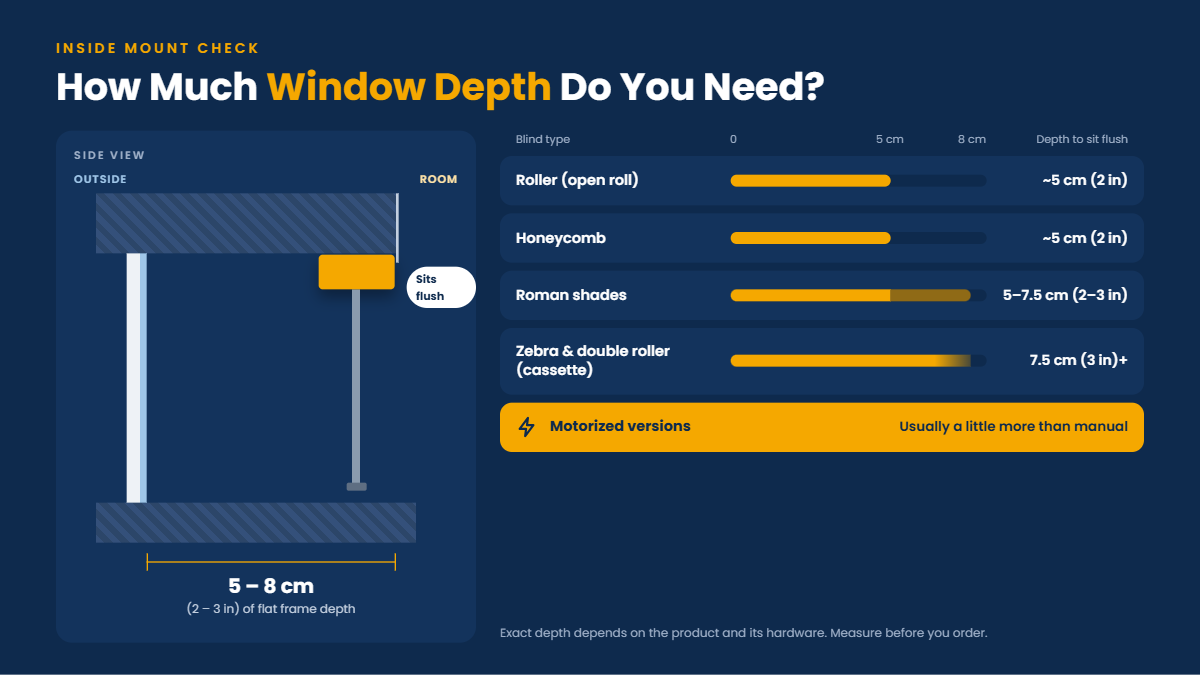
Most inside mount blinds need roughly 5 to 8 cm (2 to 3 inches) of flat frame depth to sit flush, but the exact number depends on the product and its hardware.
Blind type | Typical depth to sit flush |
|---|---|
Roller blinds (open roll) | About 5 cm (2 in) |
Zebra and double roller blinds (cassette) | About 7.5 cm (3 in) or more |
About 5 cm (2 in) | |
About 5 to 7.5 cm (2 to 3 in) | |
Motorized versions | Usually a little more than the manual version |
These are typical planning figures. Exact depth requirements vary by fabric, cassette, and control, so we confirm them during your measuring appointment.
 What Window Depth Do You Need for Inside Mount Blinds
To measure depth, run your tape from the front edge of the frame to the window glass or the first obstruction, such as a lock, handle, or crank. If the depth is less than the blind needs, the blind can still be partly recessed, or you can switch to an outside mount.
How Do You Measure for Inside Mount vs Outside Mount Blinds?
Use a steel tape measure, measure every window separately, and record width before height. For full step-by-step instructions, see our guide on how to measure for window shades and blinds.
Measuring for inside mount blinds
Width: Measure inside the frame at the top, middle and bottom. Use the smallest number.
Height: Measure at the left, centre and right. Use the longest number.
Depth: Check that the frame is deep enough for your chosen blind.
Don't make deductions. Give the exact opening size. The blind is made slightly narrower so it fits and operates smoothly.
Measuring for outside mount blinds
Width: Measure the area you want to cover, then add 5 to 10 cm (2 to 4 inches) on each side for overlap.
Height: Measure from where the headrail will sit, usually 5 to 8 cm above the frame, to where you want the blind to end, typically just below the sill.
Check clearance: Make sure the headrail won't hit crown moulding, a ceiling, a door or a light switch.
Not confident measuring yourself? Our free in-home measuring takes the guesswork out, and we check depth, squareness, and obstructions on every window.
Conclusion
The right answer to inside mount vs outside mount blinds depends on your window and your goals. Inside mounts give a clean, built-in look when your frames have enough depth. Outside mounts deliver better blackout, work around shallow frames and crank handles, and can make windows look bigger. Many homes use both: inside mounts in living areas and outside mounts in bedrooms.
If you're unsure which mount suits each window, book a free in-home consultation with Met Blinds, an experienced Calgary blinds company. Our team will measure every window, check the depth, and recommend the best fit for your home.
FAQs
Is an inside or outside mount better for blackout blinds?
Outside mount is better for blackout. Overlapping the frame by 7 to 10 cm on each side blocks most of the light that slips around an inside mount blind.
Do inside mount blinds look better?
Many people prefer the clean look of inside mount blinds, especially on windows with nice trim. Outside mount blinds look better on small, shallow, or uneven windows, and they also make the window appear larger.
How much should outside mount blinds overlap the window?
Add 5 to 10 cm (2 to 4 inches) on each side of the area you want to cover. Go toward the higher end in bedrooms and media rooms, where blocking light matters most.
What if my window isn't deep enough for inside mount blinds?
Choose an outside mount, or ask about a partial inside mount where the blind sits partly in the frame. Your consultant can tell you which works best for the blind you want.
Can I mix inside mount and outside mount blinds in the same room?
Yes, but keep the look consistent on windows that sit side by side. Mixing usually works best between rooms, such as inside mounts in the living room and outside mounts in bedrooms.


